
If you’ve been pulled over for a DWI, many drivers often unknowingly help the police collect evidence against themselves. Neumann & Associates at Law has seen it time and again: during a DWI traffic stop, what sounds like a quick “check to make sure you’re okay to drive” is often an evidence-gathering process designed to build a case against you. Officers may speak casually and reassure you that a few tests will get you back on the road. In reality, field sobriety testing is frequently the first step toward an arrest because these tests are not truly pass/fail “proof” of sobriety. They are tools the State uses to argue impairment, and they are graded largely by the subjective opinion of the officer on scene.
What the State must prove in a Texas DWI case
To convict you of DWI, the State must prove guilt beyond a reasonable doubt. Prosecutors typically try to do that in one of three ways: by alleging your blood alcohol concentration was 0.08 or higher, or by claiming you did not have the normal use of your mental faculties due to alcohol or drugs, or that you did not have the normal use of your physical faculties because of alcohol or drugs. That’s why officers focus so heavily on observations, statements, and sobriety testing: those pieces become the foundation of a report, an arrest decision, and often, a warrant request for a blood draw.
The “field sobriety tests” are not what most people think
Field sobriety tests can be used to suggest possible intoxication, but they do not scientifically “prove” intoxication. And many sober, unimpaired people can perform poorly under roadside conditions because of anxiety, poor coordination, injuries, age, medical conditions, uneven ground, weather, passing traffic, fatigue, or simple nervousness. Yet the officer who already suspects impairment is the one who decides whether you “passed,” which creates a real risk of confirmation bias interpreting normal human imperfections as signs of intoxication.
The eye test (HGN) and the NHTSA standards
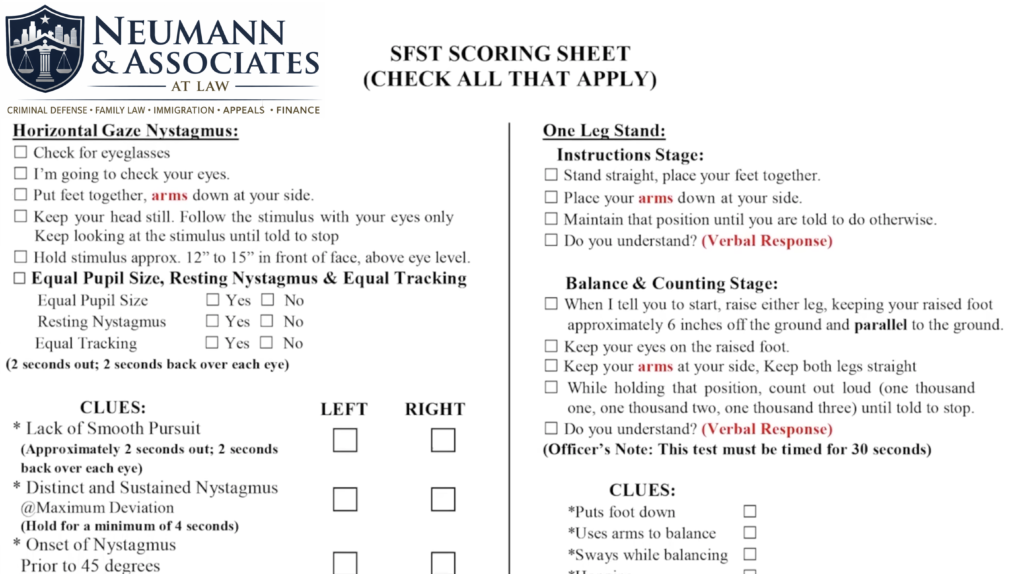
One of the most common tests is the Horizontal Gaze Nystagmus (HGN) test, often called the “pen test” or “eye test.” The officer moves a stimulus (typically a pen or finger) in front of your face while looking for involuntary jerking of the eyes that may correlate with intoxication. What many drivers don’t realize is that this test is supposed to be administered and scored according to National Highway Traffic Safety Administration (NHTSA) guidelines. Details matter such as the proper distance of the stimulus from the face (commonly taught as approximately 12–15 inches) and moving the stimulus at the correct pace. When officers deviate from NHTSA protocols, the reliability of the test can be challenged. If the test was not administered correctly or if the scoring was incorrect, your “performance” may be misleading, yet still used as justification for further testing or arrest.
The walk-and-turn: an “arrest trap” on the roadside
The walk-and-turn is a divided-attention test that requires you to stand heel-to-toe while listening to instructions, then walk heel-to-toe in a straight line, complete a turn, and return. The problem is that drivers can be marked down before the test even begins by shifting balance, stepping out of the stance, or beginning too early. In some stops, officers even ask drivers to walk an imaginary line, which invites subjectivity and disagreement about what “straight” even means. This test is frequently portrayed as simple, but it is easy for sober people to struggle when stressed, cold, tired, or standing on uneven pavement.
The one-leg stand: small “clues” become big consequences
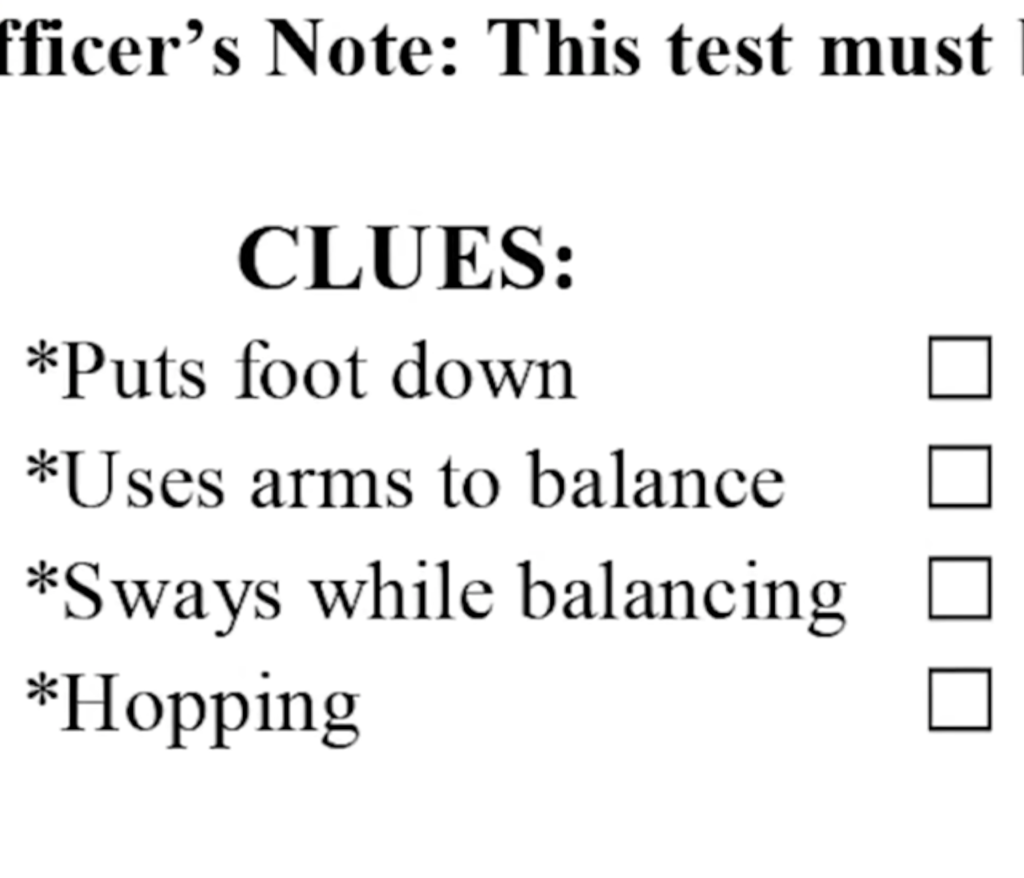
The one-leg stand requires balancing on one foot while keeping arms at your side and counting aloud for a set period (often 30 seconds). Officers are trained to look for “clues” such as putting the foot down, hopping, swaying, or raising arms. You can maintain balance and still be marked down based on minor movements that have nothing to do with alcohol especially if you have back or knee issues, vertigo, past injuries, or simply poor balance. The officer’s interpretation often becomes central evidence in the case.
“Extra tests” are not standardized—and they usually only hurt you
Many officers also request additional “tests” such as reciting the alphabet, counting backward, touching your finger to your nose with eyes closed, leaning back while looking upward, and similar tasks. These are often not standardized in the same way as the NHTSA battery, and they can create more statements and more video “moments” for the State to argue impairment. The more you do, the more material exists to be interpreted against you.
Refusing field sobriety tests vs. refusing breath or blood: what happens to your license in Texas?
A critical point many people misunderstand is the difference between field sobriety tests and chemical tests.
- Field sobriety tests are the roadside tests like the walk-and-turn, one-leg stand, and often the HGN eye test. In Texas, refusing these roadside field sobriety tests does not, by itself, cause your driver’s license to be suspended.
- Texas driver’s license suspensions in DWI cases typically come from the Administrative License Revocation (ALR) process, which is tied to refusing or failing a chemical test, meaning a breath or blood test, not the roadside balance/coordination tests.
That said, refusing field sobriety tests can still lead to an arrest if the officer believes they have enough other evidence, and the officer may then request a breath or blood sample. If you refuse the breath or blood test, the State may seek a warrant for a blood draw, and an ALR suspension may also be triggered depending on the circumstances. Every case is different, and timing is critical, especially for protecting your license and requesting any available hearings.
Breath or blood tests, warrants, and protecting your rights
Officers commonly push for a breath or blood sample and may suggest that refusal will automatically “make things worse.” The reality is more nuanced. A breath or blood test is a search under the Fourth Amendment. If you do not consent, officers may attempt to obtain a warrant for a blood draw. Even then, the timing can matter because the State must prove intoxication at the time of driving, not hours later.
What you say after arrest matters—often more than you realize
If an arrest happens, officers may ask questions at the station about what you ate, when your last drink was, and how many drinks you had. Those questions are not casual conversation, they can be used to build a timeline and argue intoxication at the time of driving. You have the constitutional right to remain silent, and you have the right to counsel. If you are being investigated for DWI, the safest approach is usually to limit conversation and request your attorney.
If you already took tests, all is not lost
Many DWI cases are defensible, even when tests were performed. Neumann & Associates at Law examines whether the officer followed NHTSA procedures for the HGN eye test, whether roadside conditions made testing unfair, whether medical conditions or injuries affected performance, whether the officer’s instructions were confusing or incomplete, whether video contradicts the report, and whether probable cause actually existed for the arrest or for any warrant request.
Arrested for DWI in the Houston metro area? Call Neumann & Associates at Law.
A DWI charge can threaten your license, your job, your reputation, and your freedom. The earlier you involve experienced defense counsel, the more opportunities there may be to preserve evidence, challenge the stop, contest testing procedures, and protect your rights from the start.
Contact Neumann & Associates at Law today for a confidential consultation.